
Housing Service Review:
From Front Door to Temporary Accommodation
Shaping priorities and future delivery across housing service.
This work looked across the housing service end to end — from the first point of contact through to allocations and temporary accommodation — over a four-month period.
Rather than focusing on a single journey or touchpoint, we explored how the service operates across:
-
the front door and initial assessment
-
housing solutions and casework
-
allocations and placement
-
temporary accommodation and ongoing support
Project team: Head of research, Business analyst, Service designer
From a broad scope to clear direction
Working within a broad brief

The starting point for this work was intentionally broad. The aim was to build a high-level understanding of the housing journey — from the front door through to temporary accommodation — and identify opportunities to reduce pressure across the service.
This meant working within a space that was:
-
wide in scope
-
not clearly defined
-
and spanning multiple teams and systems
The challenge was not just to explore the service, but to bring enough structure and clarity to:
-
understand how it operates end to end
-
identify where pressure and demand sit
-
and highlight where meaningful improvements could be made
User profiles
Understanding different types of demand


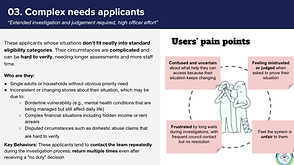
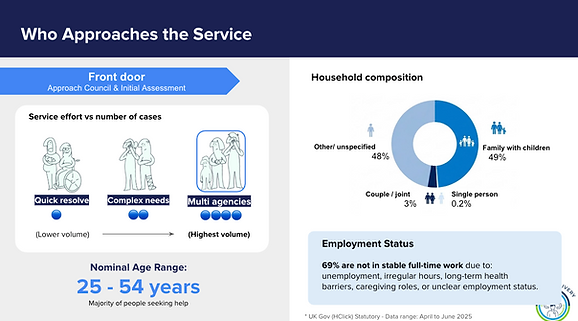
Alongside mapping the end-to-end service, we also looked at how different residents interact with it in practice.
Rather than treating all users as one group, I introduced an initial segmentation approach, which we then refined with the team based on real cases, data and operational experience.
This helped surface distinct patterns in how people move through the service — from straightforward cases that can be resolved quickly, to more complex situations that involve multiple teams, repeated contact, and ongoing support.
This added an important layer to the work — helping the team move beyond volume and better understand:
-
where time and effort are concentrated
-
which types of cases create the most pressure
-
Where more targeted support or intervention could make a difference
-
Any other support needed for potential TA tenants
Looking across the service, a set of patterns emerged.
What we uncovered

01. A fragmented service across teams and systems
The housing journey spans multiple teams, systems, and handoffs.
-
case information is stored across different places (e.g. spreadsheets, shared drives, personal records)
-
processes rely heavily on manual coordination
-
ownership is not always clear across stages
This makes it difficult to build a complete picture of a case or respond efficiently, with frontline teams often bridging gaps to keep the service moving.

03. Limited visibility of changing circumstances
The service relies on residents to proactively share updates — such as changes in circumstances — which are essential for case progression, allocations, and housing benefit decisions.
In practice:
-
communication is often one-off or inconsistent
-
residents may not fully understand what is required
-
changes are missed or delayed
This means key information is often only identified later in the journey, when it becomes harder to act on.

02. Demand driven by lack of clarity
A significant amount of contact is not new demand — it is repeat or follow-up contact.
TA tenants often:
-
chase updates
-
contact multiple teams
-
escalate when they feel uncertain
This is closely linked to:
-
unclear communication
-
limited visibility of status
-
inconsistent information across teams
-
Unclear contact routes
As a result, demand is amplified by uncertainty rather than need.

04. Lack of prevention across the journey
These issues compound over time and tend to surface downstream, when they are more complex and resource-intensive to resolve.
Teams are often working reactively:
-
responding to issues once they escalate
-
managing repeat contact
-
dealing with incomplete or delayed information
This limits the service’s ability to intervene earlier and reduce pressure more effectively.
Highlights - Priority matrix
Making the service measurable

Given the scale and complexity, one of the key challenges was understanding which problems matter most — and where to focus.
To address this, we introduced two complementary prioritisation frameworks to assess both existing issues and future opportunities, helping the team and service areas to identify where to focus first.
What we've achieved...
Final outcomes
Within a four-month period, this work provided a structured, end-to-end understanding of the housing service — from front door through to temporary accommodation.
We:
-
mapped the service blueprint for both homelessness journey and TA journey, captured internal systems, and touchpoints
-
consolidated previously fragmented artefacts (e.g. spreadsheets, workflows, and communication points) into a clearer service view
-
identified and synthesised high-level issues across the journey
-
prioritised opportunities based on impact and feasibility
-
developed a set of recommendations from a whole-service perspective
This created a strong foundation for the next phase of work.
Our team is now working closely with the transformation team to shape a more collaborative, end-to-end approach to improving the housing service — particularly across the front door and temporary accommodation journey.